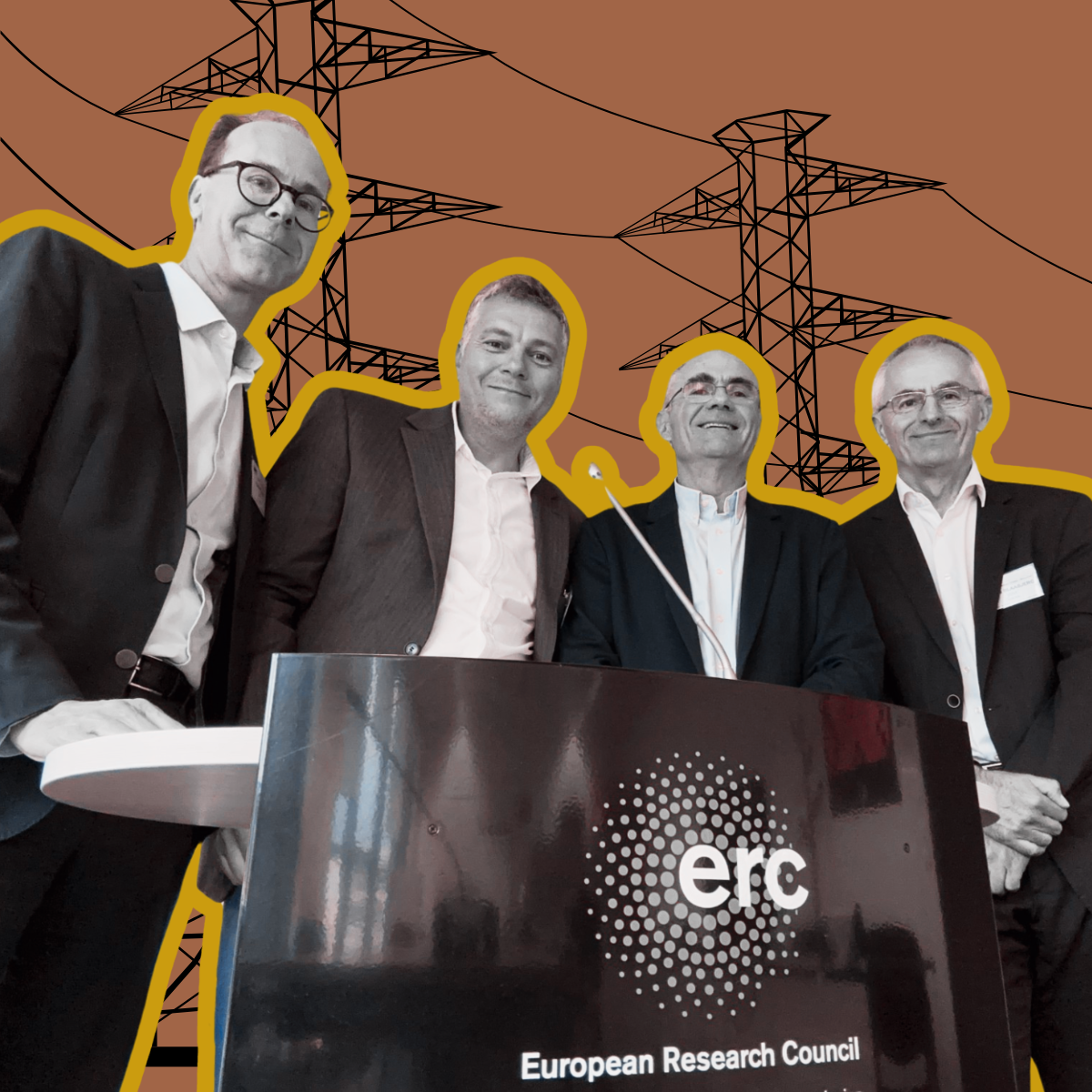

The largest grants from the European Research Council were November 5—one of the grants will kickstart work on developing the climate-friendly power grid expansions of the future through a collaboration between Aalborg University and RWTH Aachen University in Germany.
By Tor Bagger and Niels Landbo Krogh, AAU Communications and Public Affairs
The global power grid is still based on the same fundamental principles and equipment as it was over 100 years ago, but as everything becomes electrified, there is a need to rethink the power grid. A team of researchers in Denmark and Germany has now received substantial financial support for this major undertaking.
With a research grant of more than 11 million euros from the European Research Council (ERC), Aalborg University and RWTH Aachen University in Germany will develop and test new hardware and electrical system logic. Specifically, 3.1 million euros (approx. 23 million Danish kroner) will be allocated to Aalborg, where approximately ten employees will be hired and advanced equipment will be purchased.
“One of the reasons we need to drive progress in this area is that, in the coming decades, we’ll need to significantly expand the power grid to make our energy supply far more climate-friendly. We have some ideas on how the power grid can be better utilized in the long term, which might allow us to reduce the scale of the expansion, but there are some issues we need to get under control before we can say whether this can succeed on the scale we hope for,” says Professor Frede Blaabjerg about the work that lies ahead for him and the other researchers in the coming years.
The power plants of the Industrial Revolution, with their large synchronous generators, led, among other things, to the development of iron and copper transformers to distribute the energy, connecting everyone to a common grid. If the entire grid fails, it affects a great many consumers, and as the power grid of the future becomes much larger, failures will have major consequences.
The power grid is becoming more segmented and resilient
The new power grid structure, which will be developed as part of the research project, is based, in part, on electronic transformers using power semiconductors, which enable the power grid to become more segmented and more resilient to faults—inspired, among other things, by the structure and flexibility of the Internet.
“Among other things, we’re receiving funding to better manage energy in the power grid by using these electronic transformers instead of traditional transformers. We believe that by using electronic transformers, we can enable the local power system—that is, the distribution grid—to make better use of locally produced energy without having to send it far away. And if we get better at this, we can achieve a more reliable power grid in the long run,” explains Frede Blaabjerg.
This is the second time Frede Blaabjerg has helped bring one of the major and highly prestigious ERC projects to Aalborg University. His own field of research, power electronics, is central to the new interdisciplinary project, which also draws on expertise in power grid management, computer science, and the Internet, as well as business models for the new grid structure.
North Jutland Context
Another key figure in AAU’s participation in the upcoming project is Assistant Professor Subham Sahoo, who conducts research in electricity and AI.
“I was at MIT in Boston when we were working on the application and submitted it, but thanks to an outstanding team of talented senior researchers, we could already feel the synergy as we worked on it. It was in itself a fantastic learning experience to work with such extremely dedicated researchers—Sebastian Schwartz, Mirko Stoffers, and Patrick Pollok from RWTH Aachen. A great team and an incredibly ambitious and innovative scientific vision—that’s music to any researcher’s ears,” says Subham Sahoo, who joined AAU Energy in 2019 after earning his Ph.D. at the Indian Institute of Technology Delhi and completing a postdoc at Nanyang Technological University in Singapore.
The substantial grant from the European Research Council is due, in part, to the fact that the research could have international significance, but some of the research must be conducted in North Jutland, where there is already a focus on the challenges facing the power grid of the future.
For example, Business Region North Denmark is advocating for central government investment to expand the capacity of North Jutland’s power grid so that, by 2030, it can handle a fourfold increase in onshore renewable energy capacity. The organization believes that the power grid in North Jutland has been underprioritized for many years compared to the rest of the country, and that this is detrimental both to the green transition and to job and growth opportunities in North Jutland.
The article was originally published on aau.dk, where the project abstract, among other things, can also be found.